
The Importance of CoQ10 for Your Health
- , by SANUSq Research team
- 8 min reading time

Every heartbeat, every thought, every movement runs on cellular energy — and one coenzyme sits right at the heart of making it. Yet levels quietly fall as we age.
Coenzyme Q10 (CoQ10), also called ubiquinone, is found in virtually every cell in the body — its name literally means "everywhere." It's especially concentrated in the hardest-working, most energy-hungry organs: the heart, liver, kidneys and immune system. Understanding CoQ10 benefits starts with understanding two things it does exceptionally well: helping make energy, and fighting free radicals.
The body makes its own CoQ10 and gets some from food (oily fish, organ meats, and plant foods like spinach, broccoli and legumes). But production declines with age, and certain conditions — and notably statin drugs — deplete it further.
Coenzyme Q10 functions: energy and antioxidant defence
CoQ10 and energy production
CoQ10 is an essential part of the team — alongside B vitamins, magnesium and others — that makes ATP, the body's energy currency, inside the mitochondria (the cell's "powerhouses"). Without adequate CoQ10, energy production falters. This central role in coq10 energy production is why deficiency shows up first in high-demand tissues like the heart.
It is worth seeing exactly where CoQ10 sits in that machinery. Inside the mitochondria, energy production runs along a sequence of protein complexes embedded in the inner membrane — the electron transport chain. Electrons stripped from food are passed down this chain, and the energy released is used to pump protons across the membrane, building a gradient that finally drives the enzyme assembling ATP.
CoQ10's job is to be the shuttle. It is small, fat-soluble and mobile within that membrane, which lets it collect electrons from the earlier complexes and ferry them to the next one along — a role nothing else in the chain performs. If the shuttle is in short supply, the chain slows, and with it the rate at which ATP can be made. That is the concrete meaning of "energy production falters", and it is why the tissues that notice first are the ones that never stop working.
CoQ10 as an antioxidant
CoQ10 is also a potent antioxidant, defending DNA, fats, proteins and cell membranes from free-radical damage. It even recycles other antioxidants — recharging spent vitamin E and vitamin C back to their active forms so they can keep working.
Carrying electrons is, in fact, what makes CoQ10 an antioxidant at all. Handing an electron to a free radical is chemically the same manoeuvre as handing one to the next complex in the chain. Because CoQ10 dissolves in fat rather than water, it does this work inside cell membranes and within circulating lipoproteins — precisely where fat molecules are most vulnerable to oxidation. That is also the mechanism behind the LDL point below: CoQ10 travels within the LDL particle itself, making it one of the few antioxidants positioned to protect that particle from the inside.
CoQ10 and cardiovascular health
The heart never rests, so it needs a constant energy supply — which is why CoQ10 is more concentrated in heart muscle than almost anywhere else. It powers the heart's tireless pumping and mops up the free radicals generated in the process, while its antioxidant action helps prevent the LDL oxidation that drives atherosclerosis.
Low heart-muscle CoQ10 is linked with more severe heart failure, and the strongest evidence comes from a major trial:
In a randomised, double-blind trial, long-term CoQ10 supplementation added to standard therapy improved symptoms of chronic heart failure and reduced major adverse cardiovascular events and all-cause mortality (Mortensen et al., 2014).
CoQ10 has also been studied for supporting healthy blood pressure and endothelial (blood-vessel) function, and for reducing the injury associated with heart attacks and cardiac surgery. In short, its benefits for the heart flow from the same two roots: energy production and antioxidant protection.
Statins and CoQ10
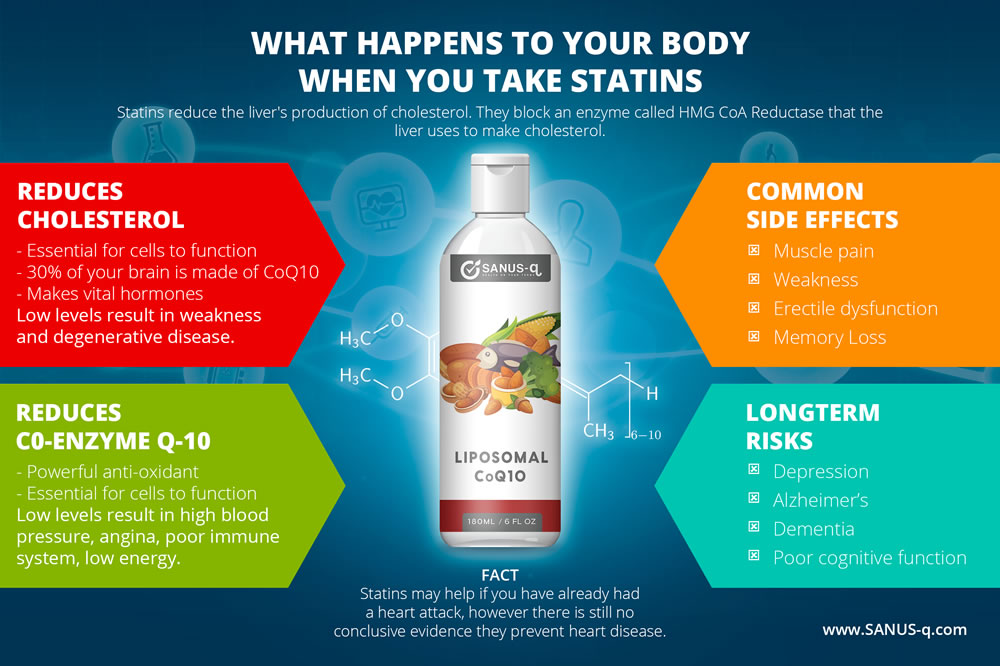
Here's a connection worth knowing if you take a statin. Statins lower cholesterol by blocking an enzyme pathway — but that same pathway also produces CoQ10, so statins can deplete the body's CoQ10. Since CoQ10 is vital for muscle and heart energy, this depletion may contribute to the fatigue, aching joints and muscle weakness some people experience on statins. Research suggests CoQ10 supplementation can ease statin-related muscle symptoms in some people. If you're on a statin and experiencing these effects, it's worth discussing CoQ10 with your doctor rather than acting alone.
Support your cellular energy
CoQ10 powers the mitochondria and protects the heart — and levels fall with age and statin use. SANUSq's liposomal CoQ10 is formulated for absorption.
Other CoQ10 benefits
Because energy and antioxidant defence underpin so much of how the body works, CoQ10 has been studied in a wide range of areas — supporting healthy energy levels and reducing fatigue, healthy ageing, immune function, blood-sugar balance, migraine prevention, gum health, and male fertility (sperm motility). Evidence varies by area, but the common thread is CoQ10's fundamental role in cellular energy.
What the evidence does and does not establish
The heart-failure trial described above is the strongest piece of evidence on this page, and it is worth being precise about what it tested: people with chronic heart failure, taking CoQ10 in addition to their standard therapy, not instead of it. That is not the same as evidence that CoQ10 improves a healthy heart, and it says nothing about whether someone without heart failure would gain anything. The wider list in the section above is a list of areas CoQ10 has been studied in, not a list of settled results — the quantity and consistency of the research varies a great deal between them.
Two cautions follow from that. CoQ10 is not a substitute for prescribed cardiac medication, and nobody should adjust their treatment on the strength of a supplement. And interactions with anticoagulant (blood-thinning) medicines have been reported, which matters because those medicines are dosed and monitored on a fine margin. Anyone taking one, or any other heart medication, should raise CoQ10 with their doctor or pharmacist before starting it rather than deciding alone.
Frequently asked questions
What does CoQ10 do in the body?
Its two main coenzyme Q10 functions are helping the mitochondria produce ATP (cellular energy) and acting as an antioxidant that protects cells and recharges vitamins C and E. These underpin its benefits for the heart, energy and healthy ageing.
Who might benefit from CoQ10?
CoQ10 levels fall with age and are lowered by statin drugs, so older adults and people on statins are often discussed. It's also studied in heart failure, high blood pressure, migraine and fatigue — always best considered with your doctor, especially alongside medication.
Does CoQ10 help with statin side effects?
Statins can deplete the body's CoQ10, which may contribute to muscle aches and fatigue. Some research suggests CoQ10 supplementation eases these symptoms in certain people, but if you're on a statin, discuss it with your doctor before adding CoQ10.
Why is CoQ10 concentrated in the heart?
Because CoQ10 works inside the mitochondria, and the density of mitochondria in a tissue tracks how much energy that tissue uses. Heart muscle contracts continuously and never gets a rest, so it carries an unusually heavy mitochondrial load — and with it, an unusually high CoQ10 requirement.
Where do I get CoQ10 from food?
Oily fish (sardines, mackerel), organ meats, and plant foods such as spinach, broccoli, cauliflower and legumes all supply CoQ10. Cooking and processing reduce the amount, and the body's own production declines with age.
References
- Mortensen SA, Rosenfeldt F, Kumar A, et al. The effect of coenzyme Q10 on morbidity and mortality in chronic heart failure: results from Q-SYMBIO: a randomized double-blind trial. JACC Heart Fail. 2014;2(6):641–9. PMID 25282031
Read more on the blog
Watch on YouTube
Explore more on our channel, @SANUSqHealthSupplements.
We wish you good health on your terms.
The team at SANUSq.
PS. Curious what's currently on offer? Take a look at our latest promotions.
The health information in this article is provided for educational purposes only. Consult your healthcare professional before making any medical decisions.
Regulatory Notice
The information on our websites, blogs, and emails is provided for informational purposes only and has not been evaluated by the EMA, EFSA, or FDA. It is not intended to replace medical advice provided by your healthcare professional, and is not intended to diagnose, treat, cure, or prevent any disease. Our products are intended for adults aged 18 and over. While the vitamins and supplements mentioned may offer various health benefits, supplements and dietary changes should be considered part of an overall health plan and not a substitute for professional medical treatment. Only a qualified healthcare professional can provide personalized advice and treatment plans based on your individual health needs and medical history; you should consult your healthcare professional before taking any product(s) if you are pregnant or breastfeeding.